





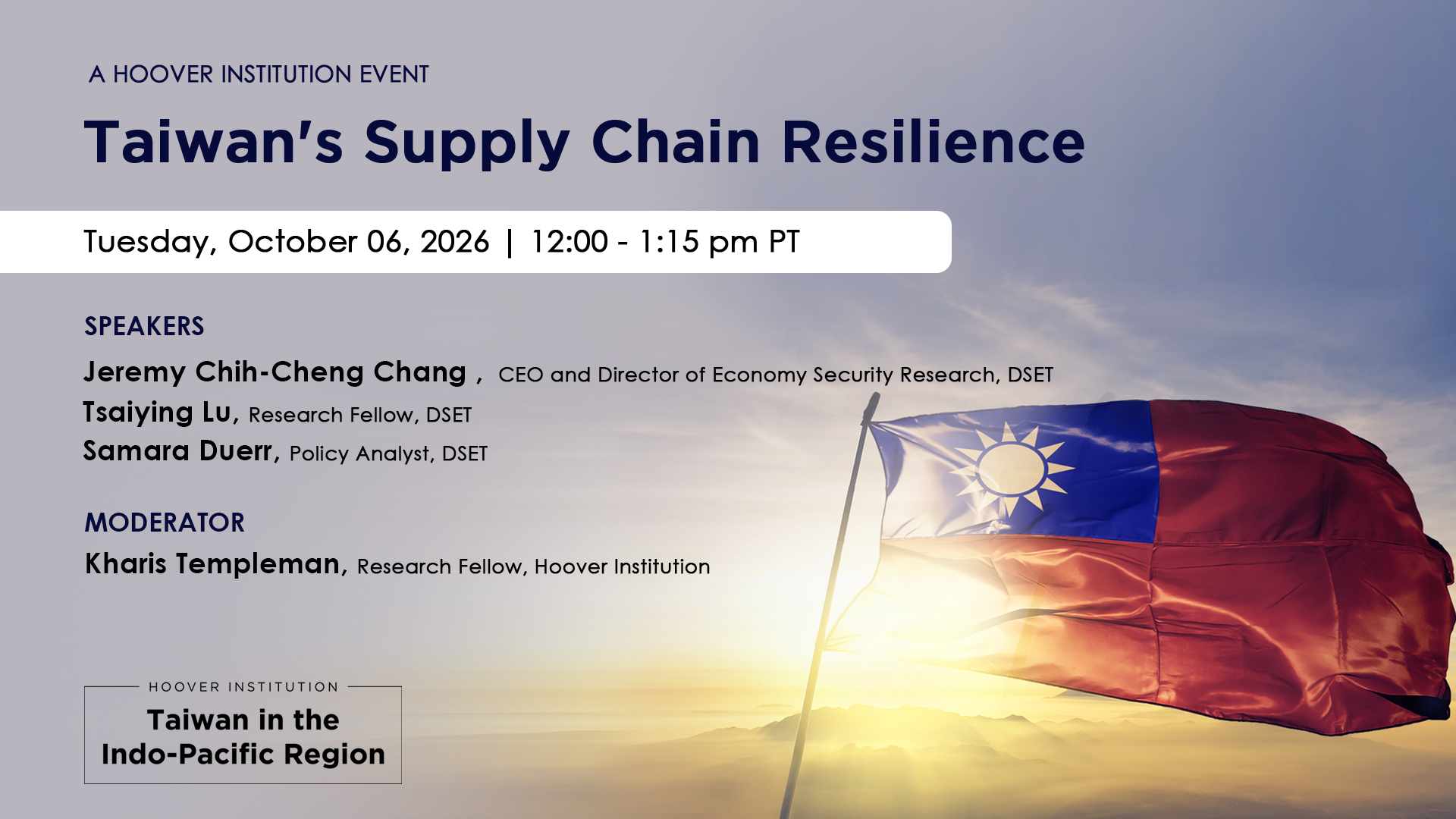
The Hoover Institution program on Taiwan in the Indo-Pacific region hosted Taiwan's Supply Chain Resilience on October 6, 2026.
Over the last decade, Taiwan has become increasingly central to the supply chains that underpin the U.S. economy. It is well-known now that Taiwan’s semiconductor industry produces the critical advanced microchips that are making possible the AI revolution. But American firms seeking to derisk from the People’s Republic of China have also sought to source critical parts from alternative sources, and Taiwan has reemerged as an attractive alternative to ensure “non-red” supply chains.
This roundtable will examine Taiwan’s supply chain resilience across three strategically important sectors: semiconductors, drones, and energy. Featuring three experts from the Taiwan-based think tank Democracy, Society and Emerging Technology (DSET), the discussion will explore the vulnerabilities and strategic challenges facing Taiwan’s supply chains, as well as ongoing efforts to strengthen their resilience. Speakers will assess how Taiwan can diversify critical supply chains, reduce exposure to external disruptions, and deepen cooperation with international partners including the United States. The roundtable will conclude by considering the implications of Taiwan’s supply chain resilience for economic security and regional stability.
Speakers
Jeremy Chih-Cheng Chang is a legal researcher and policy think tanker on geopolitics and technology law & policy. He serves as the Chief Executive Officer and Director of Economic Security Research at the Research Institute for Democracy, Society, and Emerging Technology (DSET) under the National Science and Technology Council, Taiwan. He has developed a public policy career as a legal scholar in Japan’s technology policy-making sphere, working at the National Graduate Institute for Policy Studies and the Japan Science and Technology Agency. His expertise covers safeguarding critical national technologies, including export control, foreign investment, trade secrets, security clearance, and compliance policies. He also addresses tech and industrial policy issues related to economic security and the resilience of the semiconductor supply chain in the U.S., Japan, and Taiwan. Before, he served as Assistant Professor at Kyoto University from 2016 to 2018. He conducted post-doctoral research at Harvard University in the academic year 2017 to 2018. He earned his Ph.D. in Law from Kyoto University in 2016 and his LLM degree from Cornell Law School.
Tsaiying Lu is a Research Fellow and Director of the Energy Security and Climate Resilience Program at DSET. She holds a Ph.D. in History from the Maastricht University in the Netherlands. Lu’s research interest lies in Taiwan’s energy transition, emerging net-zero technologies, and new energy geopolitics. Her team’s work focuses on critical issues, including Taiwan’s energy security and resilience during the potential Taiwan Strait Crisis, Taiwan’s strategic position in the new energy supply chain and multinational cooperation (e.g., third-generation solar modules, hydrogen, and sustainable aviation fuels), an analysis of the water and electricity use of Taiwan’s semiconductor industry, and China’s climate diplomacy, among others. Her research results and media interviews have been published in Nikkei Asia, The Diplomat, Deutsche Welle, Australian Broadcasting Corporation, East Asia Forum, and other international media and forums.
Samara Duerr currently serves as a policy analyst for the National Security and Dual-use Technology (NSDT) taskforce at Taiwan’s government funded Research Institute for Democracy, Society, and Emerging Technology (DSET). Samara earned her Master’s degree in Asia Pacific Studies at National Chengchi University in Taiwan and received a Bachelor’s degree in International Relations and Chinese Studies at Emory University in the US. She has also studied at Yonsei University in Seoul and the School of Oriental and African Studies (SOAS) in London. With an emphasis on techno-geopolitics, her work specializes in the drone supply chain, emerging technology, and Taiwan-US relations. Her work has been featured in The Diplomat and CommonWealth Magazine, and she has been quoted in The Economist, Nikkei Asia, the Indo-Pacific Defense Forum, The American Chamber of Commerce, Intelligence Online, RTI News, Focus Taiwan, Public Television Service (PTS) Taiwan, Taiwan Liberty Times, Tech News Taiwan, China Times, and China Review News Agency.
Moderator
Kharis Templeman is a Research Fellow at the Hoover Institution and program manager of the Project on Taiwan in the Indo-Pacific Region, as well as a lecturer in the Department of East Asian Studies at Stanford University. A political scientist by training, he writes and speaks frequently about cross-Strait relations and Taiwan politics and policy issues.