





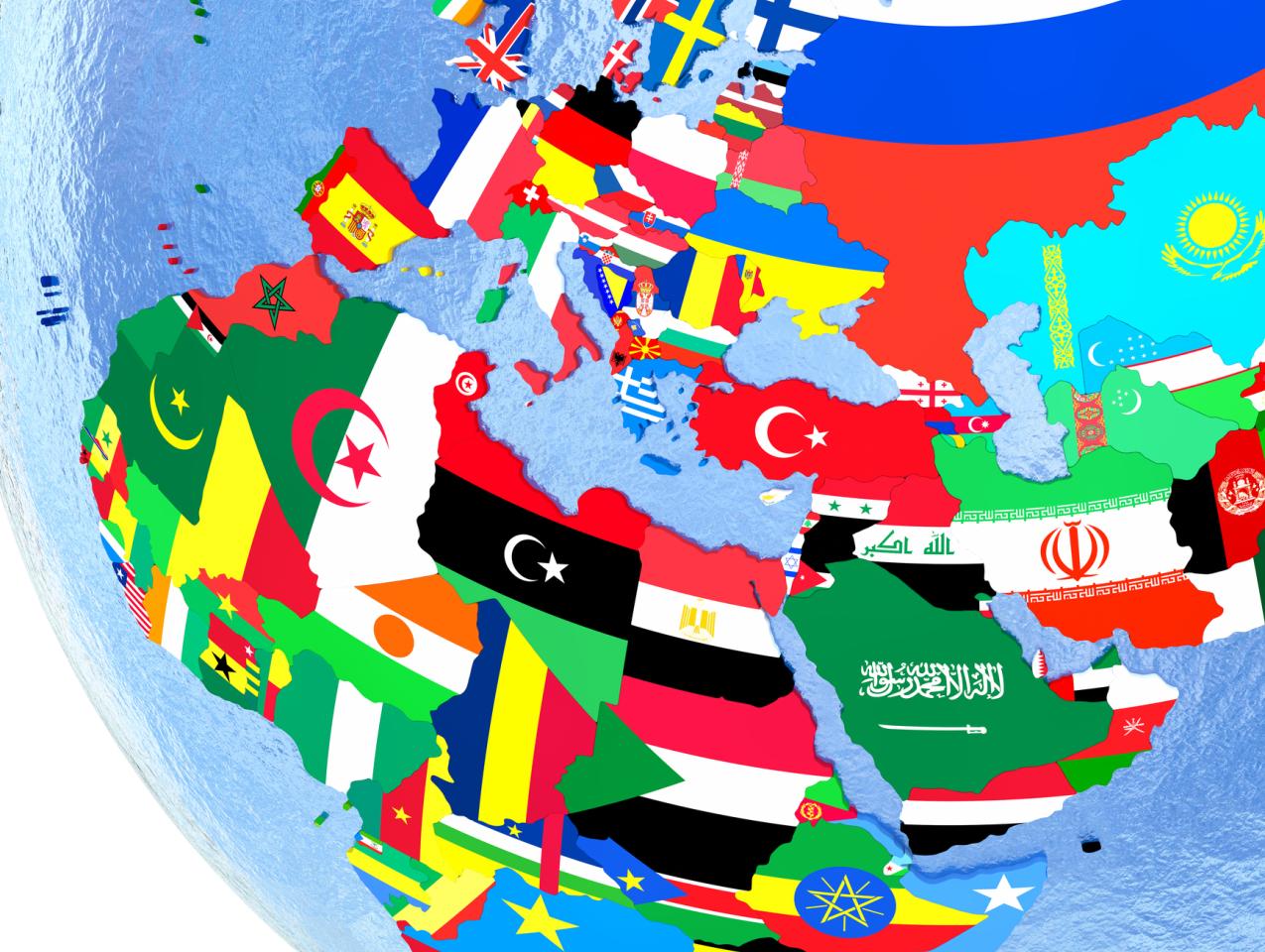
- Middle East
The current geopolitical picture on Europe's doorsteps is, to say the least, dynamic. The neighborhood is changing quickly. One of the shortcomings of our European way of thinking that limits our vision is a deeply rooted eurocentrism. We Europeans often, wrongly, think that our European ideas, values, priorities, our world view and very often our funding are fundamentals that determine what can happen far beyond our borders. This is however just not the case. We inhabit a global world from which ideas, innovative technologies, funding and interests originate. We face other power centers that are not at all timid in protecting their interests and values without hesitation, and they do so through investment, trade, politics and sometimes by force.
The Latvian Context
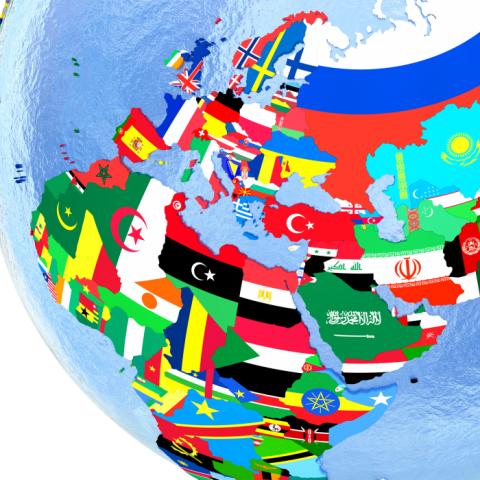
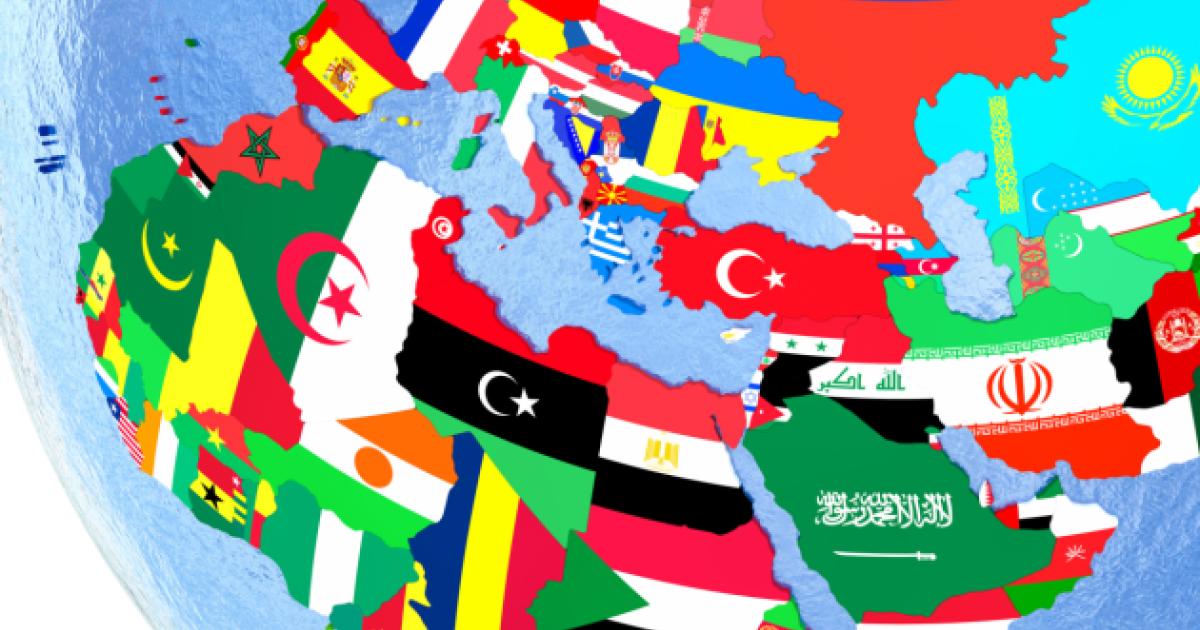
When we look at the political maps of Europe and the Middle East, we can easily be led to the conclusion that what happens far away in the Middle East does not matter for Europe's North, to which Latvia belongs. During the days of the partition of the Ottoman Empire after the First World War and the establishment of European spheres of influence in the Middle East as a result of the Sykes-Picot diplomacy, Latvia was on its own way to independence and understandably focused completely on achieving international recognition. That recognition came in January 1921 at the Paris Peace Conference. What was taking place at the same time in the Middle East was not particularly relevant for Riga, but this does not mean that Latvia through its history lacked profound associations with the Middle East.
From the end of the 12th century, the people who lived in what today is Latvian territory encountered the spread of Christianity and with it an awareness of the geography of the Holy Land. During the 13th century the Northern Crusades significantly delayed state building processes in the Baltic region but strongly tied the territory to Western Christianity. What early Latvian Christians acquired was therefore knowledge of the Middle East along with the dogmas of religion.
Latvia's history cannot in fact be separated from the history of religious knight orders: the Livonian Brothers of the Sword and the Teutonic Order. The first operated on the basis of the same rules as the better known Christian Order in the Middle East, the Templars. The Teutonic Order arrived in the Baltics while remaining active in the Middle East until the ascent of Mamluks at the end of the 13th century. These crusader orders ensured direct, long-term interaction between the Baltic region and parts of the Middle East, especially the Levant.
A further direct, historical bond between the territory that would become Latvia and the Middle East came through the presence of a centuries old and large, very vibrant Latvian Jewish community. Starting in the 1920s, many Latvian Jews emigrated to Palestine. During the Soviet occupation of Latvia from 1940-1991, a large segment of Soviet Jewry and their families lived in Latvia, many of whom emigrated to Israel between1968 and 1980. There are consequences today: Latvia allows its citizens to have dual citizenship with another country, and this applies to our citizens living in the State of Israel. There are around 6,000 Latvian nationals in Israel and a large part of them hold Latvian citizenship.
The horrific tragedy of the Holocaust strongly affects Latvia’s contemporary perspective on the Middle East. The genocide carried out by the Nazis during World War II took place on the territory of the Latvian state that had been de facto destroyed: the Republic of Latvia did not commit this unprecedented crime against humanity. The state was dismantled by the consecutive Soviet and German Nazi occupations. The guilt lies with Hitler's regime of the Third Reich. The Shoah claimed the lives of 70 000 Latvian Jews and 20 000 Jews brought from other countries. The shameful fact that ethnic Latvian collaborators participated in this crime has left modern Latvian society with a deep and genuine sympathy towards the Jewish people and the State of Israel.
So Latvia has no lack of either historic or modern interaction with the Middle East. It primarily gained its perspectives from the Judeo-Christian heritage and the interaction between the peoples of Latvia and the State of Israel. During the long years of the Soviet occupation, Soviet authorities did not allow direct interaction between occupied Latvia and the Arab world. Therefore, there is not a significant number of Latvian citizens with Arab ancestry nor is there a historical, long-standing relationship with the Arab states.
European Context
In order to address this problem, the office of a special EU High Representative/Vice President of the European Commission was established, responsible for the execution of what the member states agreed upon in terms of foreign and security policy. The High Representative was empowered to establish the EU Diplomatic Service and to lead it. This reform added global visibility to the EU, based on approved strategic vision documents and a professional EU Diplomatic Service. However, it has not yet strengthened the ability of Member States that are geographically and politically diverse to agree on external policy positions when their internal political inclinations significantly differ. The statements on which the EU can agree in these situations is perhaps good enough for public communication.
As important as the past undoubtedly is in framing contemporary policies, it is certainly not the exclusive factor shaping our present. Science, technological progress, climate change, the capacity to project strategic military power, the availability of natural resources, demography, the ability—or inability—to live with and accept diverse ethical and morality standards within established political systems: all that is at least as relevant, if not more so, as the journey through history.
In 2004, the EU underwent one of its strategically most important transformations by embracing a large group of European states from the continent's East, Center, South and North. Latvia was part of this expansion. It was a profound political unification of European democracies and an enlargement of the European Single market. However, this growth came with the risk that the EU might become strategically less coherent due to very different histories, especially the antithetical post-WWII experiences of the founding members in the free world and the newcomers who underwent Communist rule. One had to expect that this discrepancy would have ramifications in the expanded EU.
In order to address this problem, the office of a special EU High Representative/Vice President of the European Commission was established, responsible for the execution of what the member states agreed upon in terms of foreign and security policy. The High Representative was empowered to establish the EU Diplomatic Service and to lead it. This reform added global visibility to the EU, based on an approved strategic vision document and a professional EU Diplomatic Service. However, it has not yet strengthened the ability of Member States that are geographically and politically diverse to agree on external policy positions when their internal political inclinations significantly differ. The statements on which the EU can agree in these situations is perhaps good enough for public communication, but they fall short of the goal of enabling the genuine actions on the strategic level that would be required by both European interests and geopolitical realities beyond European borders.
The EU still lacks deep enough political integration sufficient to overcome this weakness in policy formulations. The European External Action Service was established on the bases of the EU Lisbon Treaty that entered into force in 2009. In the treaty, the Member States agreed to strengthen the role of the EU High Representative for External policy. It was envisioned that the High Representative and the EU External Action Service would be the linchpin of a coherent foreign and security policy, developed by the EU member states and the EU External Action Service. Yet the problem remains that when it comes to foreign and security policy, EU decisions have to be agreed upon unanimously by all 27 governments of the Member States. To get to a unanimous decision poses a major challenge. In contrast, the EU external trade policy and economic policy belongs to the European Commission where unanimity is not required. This alternative arrangement allows for more dynamics in decision-making, as would be expected.
At the same time the EU has at its disposal an impressive pool of means to support a strategic game. If one looks through the lens of combined resources available to Europe today, one can see that in 2026 the EU27 has a population of 452 million, and the Gross National Income reaches about 19,28 trillion Euro. (The European Commission’s budgetary commitment appropriations are around 1% of it). The EU27 has a 454 billion Euro ($503 billion) combined military budget (2,4% of the bloc’s combined GDP) in comparison to the $975,6 billion of the US, UK $92,4 billion of the UK, $277 billion of China, and $207,8 billion of Russia (according to the Stockholm based SIPRI). In addition to these fundamentals, the EU possesses a strong soft power appeal as the region of democratic nations. That is, at least, how we Europeans see ourselves.
Because the current geopolitical picture on Europe's doorstep is very complex and is changing quickly, the EU and its members need the ability to safeguard their interests and not lose clarity of sight. For Europe, the post-Cold War alarm clock rang twice - in August 2008 in Georgia and in February 2014 in Ukraine. The strategic awakening came later in February 2022 when Russia started its full scale military invasion in Ukraine. But what about geopolitics Middle East?
Middle East Context
In the Middle East, where the geopolitical fundamental had been established after the First World War by European powers, the political status quo remained relatively stable until the beginning of Arab revolutions in 2010. That old order is gone, but a new one is neither present nor clear. The Middle East today is a very different from what it was in the final decades of the twentieth century. New regional financial and political centers have emerged, but the old ones of the Arab `Fertile Crescent` have lost significant parts of their traction. The regional balance of power has been significantly altered. The old Cold War superpower rivalry has gone, but new players like China are increasing their presence.
Contrary to predictions a decade ago that the US would lose its interest in the Middle East, the opposite is the case. Relations with Washington are critical not only for the State of Israel, but also for Saudi Arabia, the Gulf States, Egypt, Jordan, Syria and Iraq as well. Although critical for security and stability of the Middle East, the Israeli-Palestinian Peace process no longer dominates the discourse as the single most important national security concern in regional capitals, with the exception of the Hashemite Kingdom of Jordan where due to its geography and the numbers of Palestinian refugees, the Israeli - Palestinian dynamics retains its historic prominence.
EU policy towards the Middle East is as ambitious and effective as the ability of the Member States to put aside their national preferences and agree on a common interest. The EU is a by far more homogeneous and integrated group of nation states than anything one can find in the Middle East. The famous “Who do I call?” remark by former US Secretary of State Henry Kissinger these days applies more to the Middle East. If the EU has an urgent issue on Middle Eastern security, who does one call? Cairo, Riyadh, Tel-Aviv, Abu-Dhabi? Historically, one of the sources of Middle Eastern instability has been the combination of great power and regional power rivalry competing for dominance in the region. It still plays a role today and will continue to do so for many years.
I served as Ambassador in Egypt, the most populous state, which used to be known as the dominant regional power. Interacting with her historically has been of great significance for European powers, the US, and the Soviet Union. Today, China, having become an economic and military superpower, has joined the club. Chinese economic presence and China's technological clout may contribute to increasing Cairo’s revenue flow. However, it might also have the effect of reducing pressure from international financial institutions for Egypt to undertake free market reforms so as to transform the structure of the economy. If so, this is not good news for the majority of European businesses, as well as North European entrepreneurs, for whom more free market-based reforms are the precondition for the business cooperation.
At the same time, American priorities have clearly moved away from Egypt to the Gulf countries that have experienced enormous economic growth due to abundant energy resources, available capital and the sort of reforms that attracts global markets. In addition to these economic advantages, political aspects also play a big role. The success of the Abraham Accords is vital for peace in the Middle East because it would strategically solidify relations between the State of Israel and the Arab nations. It would hopefully bring more security to all Arab states and Israel, and it would provide new opportunities to implement the long overdue two-state option that remains the precondition for peace in the Middle East.
The perspective from Northern Europe
North European nations have the same interests in Middle East - free trade routes and safe and secure data transfer lines with Asia, access to energy resources, both fossil and renewable, genuine business opportunities, and peace and stability in the region.
The peace and stability of the Middle East is of vital importance for the EU and its Northern members for understandable reasons. Firstly, it is a precondition for reducing terrorist threats. Our streets must be safer. Secondly, the Southeast Mediterranean maritime routes, the Suez Canal, the Red Sea and Bab Al-Mandeb, and the Hormuz straits constitute one of the most important export and import maritime systems for Europe. These routes are critical for Europe's industrial and energy needs. Fewer ships in the Hormuz and in the Red Sea harms EU industries and significantly increases inflation and therefore the prices of imported Asian goods. Fewer oil tankers and LNG ships that pass through the Hormuz, means that energy becomes more expensive energy for the North of Europe.
If commercial ships are pushed to use much longer water ways to deliver Asian goods to European customers, the price for goods increases. As a result, we will be able to spend less on vital needs such as social services, healthcare, education and defense. More expensive imports also increase production costs making our exports less attractive. This applies to European agriculture products too because agriculture is very sensitive to predictable imports of fertilizers that often are transported through the same routes as oil and natural gas.
In July 2015, the UN Security Council endorsed the Joint and Comprehensive Plan for Action (JCPOA) deal that was to ensure exclusively peaceful nature of Iran’s nuclear program. The EU High Representative and three of its members - France, Germany and the UK - were among its negotiators. JCPOA was an attempt by diplomatic means to prevent Iran from pursuing a nuclear weapon. A decade has passed since then and diplomacy has unfortunately failed. There is no more deal. In addition, since the end of April this year, Iran has launched drone and missile attacks on civilian infrastructure in its Arab neighbors and has blocked free shipping in the Strait of Hormuz. This has directly affected oil and energy prices world wide, including in the Baltic Sea region.
Economic pressures in the rest of the EU, including EU's Southern members who are more exposed to the problems in the Middle East, affect us in the North as well, especially those of us that are part of the EU Single Market and the Eurozone like Latvia. If there are fewer ships in Mediterranean European ports because the Strait of Hormuz is blocked by Iran’s actions or because of disruptions in Bab el-Mandeb due to Iran’s proxy paramilitary groups like the Houthis in Yemen who target commercial vessels in the Red Sea, the EU Single Market suffers. We simply pay more for imported Asian products and have less freedom of action to channel necessary budgetary funds to other strategic priorities including defense.
Beyond the higher price tag for imported energy resources and Asian products, there is another and even more significant consequence of Iran's reckless behavior that affects Latvia and Europe’s North. Iran has been extending military support to Russia to fight the war in Ukraine, which directly affects the security of Europe and the trans-Atlantic region. This explains why there Latvia did not hesitate to support a full return to the UN’s and the EU’s nuclear-related sanction regime on Iran, a decision taken by the EU in September 2025. Iran's reckless international and regional behavior is a key destabilizer of the Middle East region and its security and wellbeing, with ramifications across Europe.
There should be no mistake: the EU and its Member States are doing everything in our power to stop this war and support Ukraine and its people. To make this effort more effective, Europe needs free and unhindered maritime trade passages in the Middle East. However, it would be wrong to assume that Europeans need freedom of navigation for trade more than others do. First, free trade is critical for the interests of Middle Eastern states themselves. Their wellbeing, prosperity, and future opportunities depend on it. Second, trade remains important for global markets because it affects prices of oil products, fertilizers, grain, and other important commodities that in turn directly impact national politics and local markets around the world. Third, it affects global capital markets because of the global importance of the Gulf capital funds.
The Bigger Picture
For the EU to strengthen its strategic game in the Middle East, it is important to for it to improve its ability to coordinate the diverse geopolitical and geoeconomics agendas of its members. It is obvious that the consequences of Russia’s aggression against Ukraine and the increased instability in the Middle East are two sides of the same coin. Both directly affect the smooth functioning of commercial value chains.
One way to stabilize the global delivery of goods and strategic commodities is to diversify transportation routes in and out of the Middle East. There is an obvious need to reduce Europe's dependency on those transport corridors which have been vital but which are not always secure. We need new, safe and cheaper transportation corridors from the Middle East.
Free passage through the Red Sea and Hormuz is among the core elements that determines the substance of relations between Europe and the Middle East. This is one of the reasons why the EU and its member states have very clearly and without hesitation expressed full solidarity and extended practical support to Arab states that have been under direct Iranian attack since April 2026. Keep in mind that the EU policies on foreign and security are agreed by unanimous decision of all 27 Member States. This protects national interests of each and every Member State ensuring that these interests are not disregarded. To agree on a common position on Middle Eastern thematics in Brussels is a task of great difficulty. But when there is an agreement, it is a powerful tool.
The Abraham Agreements have allowed the cargo flow between the United Arab Emirates and Israel to increase. When the Kingdom of Saudi Arabia joins the group, it will create a unique opportunity to pursue the strategy of the India-Middle East-Europe Economic Corridor (IMEC). This sea freight and railway transportation infrastructure project will increase supply chain security, reduce dependency on Chinese supply chains, reduce costs of shipping and will improve the integration between India, the Middle East, and Europe. It will help Europe to diversify away from dependency on Russia in the future.
For the North of Europe and its Baltic Sea region, IMEC would mean an opportunity to benefit from new transportation arteries stretching in the North-South direction. The EU already today is involved in integrating the transport networks of the Balkan EU candidate states into the single European market. When implemented, IMEC will connect the Middle East through Israel directly with ports in Greece, Italy, and France. That will also shorten the distance and time for cargo coming from India and the Middle East to Europe's North. It will reduce transportation costs and will stabilize the internal dynamics of the Middle East providing a superior alternative to the current but not always reliable maritime transportation routes through the straits of the Persian Gulf and the Red Sea. It will strengthen collaboration among transatlantic allies and partners in the Middle East. Most importantly, it will increase the strategic importance of Europe in the Middle East and beyond.
Whatever future the Middle East will face, the North European perspective is certain - it is in our interest to engage in building on shared interests and preferences, searching for long term predictability and peace in this distant but nonetheless very near region.
Andris Razāns is former Ambassador of Latvia to the US, Egypt and Jordan.